



Sirio Pharma implements an ERP system that meets computer system validation requirements.




Summary:
An ERP requirements document is the foundation for a well-founded system selection. It brings together all goals as well as functional and technical requirements, complemented by clear priorities. In the process manufacturing industry in particular, criteria such as lot traceability and validation capability are critical. A well-thought-out structure helps avoid typical mistakes such as vague requirements and minimizes risk. The result: comparable offers and a solution that meets both regulatory and practical requirements.
To find a suitable ERP system, a requirements document summarizes all requirements in a structured, written form. It makes vendors comparable, clarifies priorities, and reduces risk in the selection process. Unlike a requirements specification or a functional specification, it describes only what the system must do, not how it will be implemented.
But what belongs in such a document? From project goals and functional requirements to industry-specific criteria such as audit trails or lot traceability: this article walks you through the most important contents.
An ERP requirements document brings together all functional, technical, and organizational requirements for an ERP system. It defines clear goals, prioritizes requirements, and creates a comparable basis for system selection. In the process manufacturing industry, specific criteria come on top, such as lot traceability, audit trails, and validation capability. These ensure regulatory compliance and practical suitability in the long term.
When choosing an ERP system, you will come across a requirements document as well as a requirements specification and a functional specification. These three terms are often wrongly used as synonyms. Yet they describe clearly distinct steps in the selection process:
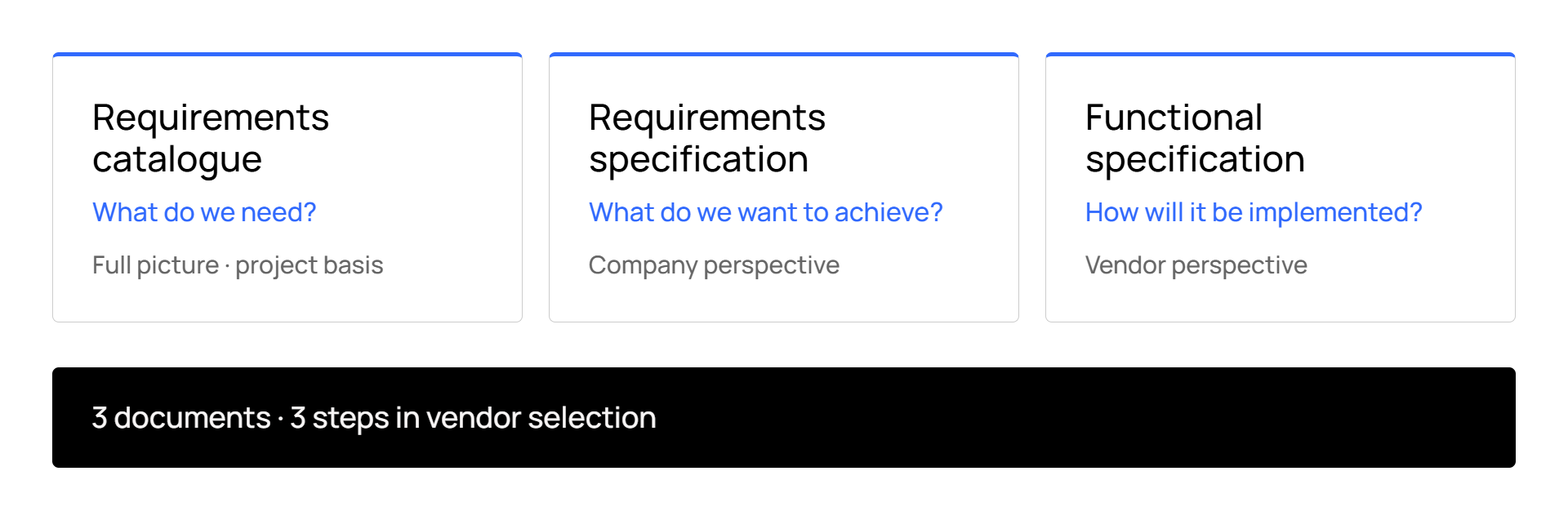
The requirements document captures all requirements in a structured way and forms the working basis for the upcoming project. The requirements specification formalizes these requirements from the company's perspective: What do you want to achieve? The functional specification then answers the counter-question: How will the technical implementation work? The answer comes from the vendor.
An ERP system forms the backbone of your business processes. Anyone who goes into the evaluation without clearly defined requirements risks choosing a system that shines but does not fit. This is where a structured requirements document comes in.
Its most important tasks:
In the process manufacturing industry in particular, one principle applies: It is not the sheer range of features that matters. Instead, focus on concrete practical examples, special cases, and regulatory requirements.
A good, well-thought-out requirements document is the basis for a decision that supports you in the long term.
A requirements document is always worthwhile. Its importance grows, however, with the complexity of your own processes. This applies in particular to:
In these scenarios, it is essential to clearly describe the requirements of the most important work processes. But what should the document cover?
An ERP requirements document is only effective if it is clearly structured. A breakdown into the following five areas has proven itself:
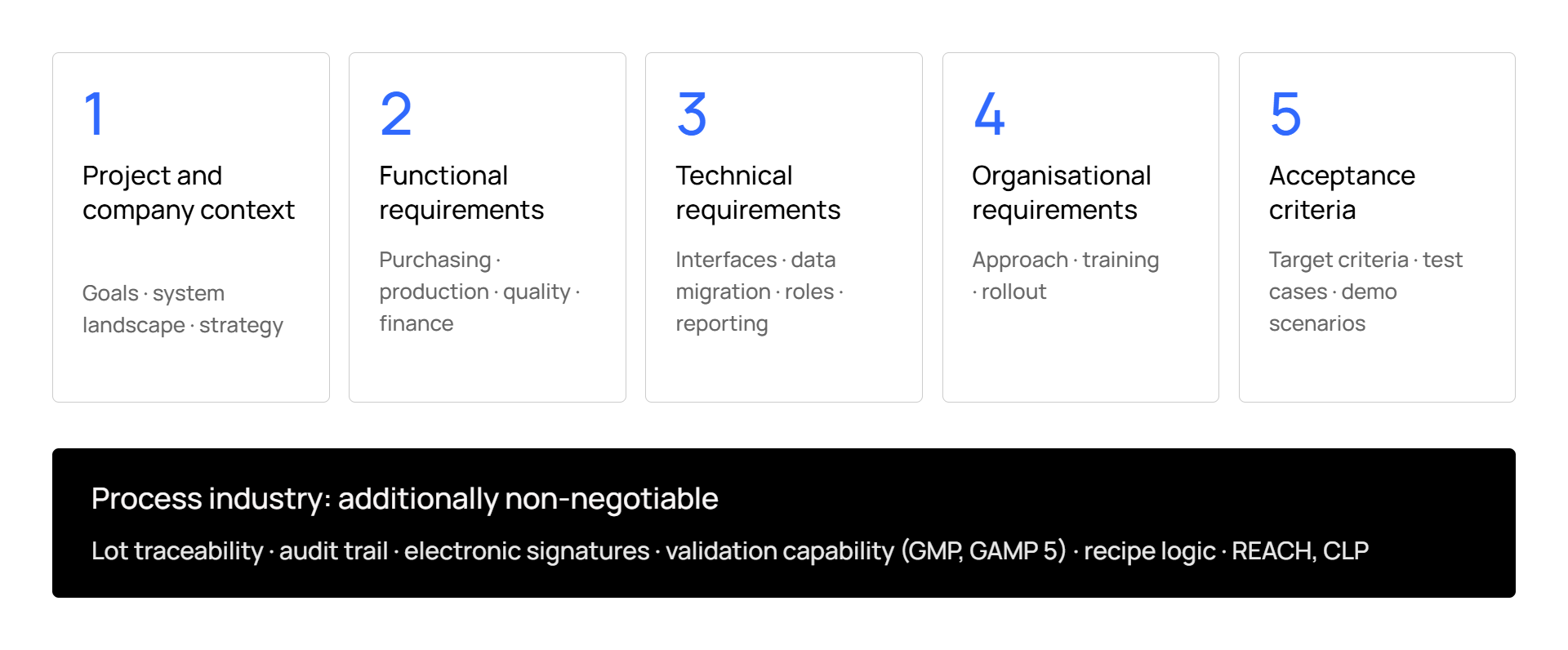
A structure like this ensures that you look at ERP requirements in the context of processes and goals.
In regulated industries, the requirements for an ERP system are particularly high. Compliance, quality controls, and transparent documentation are mandatory.
Typical requirements in the process manufacturing industry include:
Process manufacturers that do not already account for these prerequisites in the requirements document risk gaps in the system design later on, leading to lengthy and expensive adjustments.
But be careful: Not every requirements document helps. It only adds value if it is built carefully. In practice, the same weaknesses appear again and again:
The last point deserves particular attention: Only requirements formulated with practice in mind make it possible to evaluate vendors realistically.
Requirements set down in writing create a common basis for everyone involved. This can significantly improve the quality of decisions. In practice, this means:
When collecting requirements, you quickly realize there is a lot to consider. The MoSCoW method offers proven guidance for consolidating the requirements for your future ERP. It is a structured framework that creates clarity where there is often disagreement. The acronym stands for:
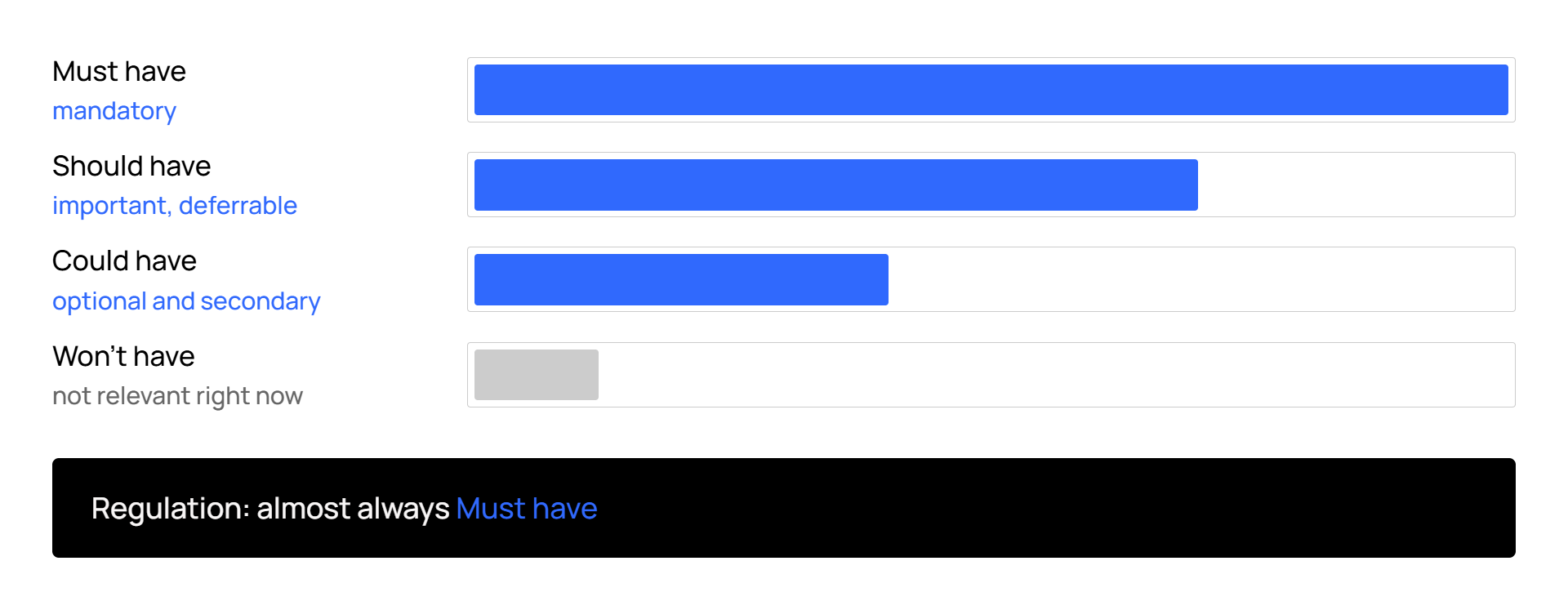
Tip: Base your prioritization on actual added value, not on individual opinions. Regulatory requirements, for example, are almost always a clear must-have, as there is little room for interpretation.
Another important step on the way to an ERP: finding the right partner. Choosing an ERP vendor is a strategic decision. It determines whether your requirements can really be implemented.
Typical evaluation criteria you can use as a guide:
A vendor that truly fits you does not just deliver software. It understands your processes, maps them, and supports you in developing them further over the long term. What it takes: an ERP solution that thinks ahead and embraces new approaches.
An ERP system that convinces today must keep up tomorrow as well. Stability alone is no longer enough. What is needed is a solution that is flexible enough to grow.
Future-proof ERP solutions are defined by clear characteristics:
A good requirements document reflects your reality: regulatory requirements, lot tracking, quality assurance. This is exactly where Yaveon comes in.
Based on Microsoft Business Central, Yaveon offers the industry-specific ERP Yaveon 365. It was developed together with customers from the process manufacturing industry and is therefore specifically suited to the pharma, biotech, chemical, medical device, food, and cosmetics industries.
What you get, among other things:
Everything runs in a single system: from purchasing and production to delivery. Data is available centrally, and manual reconciliation is no longer necessary. The technological foundation is the Microsoft Cloud, with regular updates, high security standards, and the flexibility to easily add new sites or requirements.
With this combination, you make your ERP decision on a solid basis and implement a system that works in everyday operations and stands up to regulatory scrutiny.
An ERP requirements document is a structured collection of all the requirements a company has for a new ERP system, making it the central basis for a well-founded selection and a successful implementation.
A complete document includes business goals, relevant processes, functional and technical requirements, clear priorities, and measurable acceptance criteria. In short: everything that makes a decision traceable and comparable.
It creates transparency toward ERP vendors as well as internally. Anyone who names requirements clearly can compare solutions in a targeted way and noticeably reduce project risks.
The MoSCoW method has proven effective. Requirements are divided into four categories: Must, Should, Could, and Won't. This makes it clear at a glance what is essential and what can be postponed.
A template is a good starting point, but no substitute for individual work. What matters is that the document reflects your company's specific requirements so that it can deliver its full value.
 Success story: Sirio Pharma Germany – Beitrag öffnen
Sirio Pharma implements an ERP system that meets computer system validation requirements.
 How much does an ERP system cost? – Beitrag öffnen
Estimate ERP costs realistically: which factors matter and where typical budget traps arise.
 Is your ERP driving growth or merely maintaining the status quo? – Beitrag öffnen
Find out whether your ERP drives growth or slows it down, and check how future-ready your system really is today.