
Sirio Pharma implements an ERP system that meets computer system validation requirements.



Summary:
Standard ERP software and custom software differ fundamentally in flexibility, effort, and long-term maintainability. Custom solutions map processes exactly, but often come with high costs, long project timelines, and growing technical complexity. Standard solutions are available faster and evolve reliably. However, they quickly reach their limits when it comes to industry-specific requirements. In the process manufacturing industry in particular, with its strict regulatory requirements, companies therefore need ERP solutions that deliberately combine both: the reliability of an industry standard and the depth of specialization.
For many companies weighing standard against custom software, a third route makes the most sense: an industry-specific ERP often strikes the better balance by combining proven standard processes with industry-specific features and regulatory requirements.
This article gives you a compact overview of what really matters when weighing your options and how to find the right solution for your company.
Custom ERP software is a solution developed specifically for one company or heavily modified for it. It maps existing processes exactly. Its biggest benefit is flexibility: the software adapts entirely to your workflows. Even highly specialized requirements can be implemented precisely.
At the same time, custom software also has drawbacks:
Practice shows it again and again: the real problem with custom ERP software is its long-term evolution. The more customized a system is, the more complex every change becomes. So-called technical debt builds up, meaning the effort grows with every further modification. This also creates certain limitations when it comes to today's hot topic, AI support.
Standard ERP software, by contrast, is a ready-made solution that fully covers typical business processes, usually purchasing, warehouse, production, and finance. Its benefits are fast availability and stable ongoing development. But standard software has its limits too, especially when it does not sufficiently address industry-specific requirements.
| Criterion | Standard software | Custom software |
|---|---|---|
| Implementation | fast, structured rollout | demanding, high project complexity |
| Customization | configurable and extensible | completely unrestricted |
| Maintenance | predictable, managed by the vendor | your own responsibility |
| Cost | easy to calculate | often rising follow-up costs |
| Risk | lower with standard processes | higher due to dependencies |
The comparison shows: it is not about which option is better or worse, but which one fits your company.
The benefit of custom software is obvious: it offers full flexibility. You map your processes exactly the way your company works day to day. But this freedom comes at a price that often only becomes apparent over time:
As a rule, custom development is therefore only worthwhile if your processes are so unique that they represent a genuine competitive advantage.
Standard software is “ready to go.” It stands out for its stability, comparatively short implementation times, and widely proven processes. You benefit from clear structures and reliably planned updates.
Its central weakness shows as soon as special requirements come into play. This is where the typical hurdles of a pure standard solution arise:
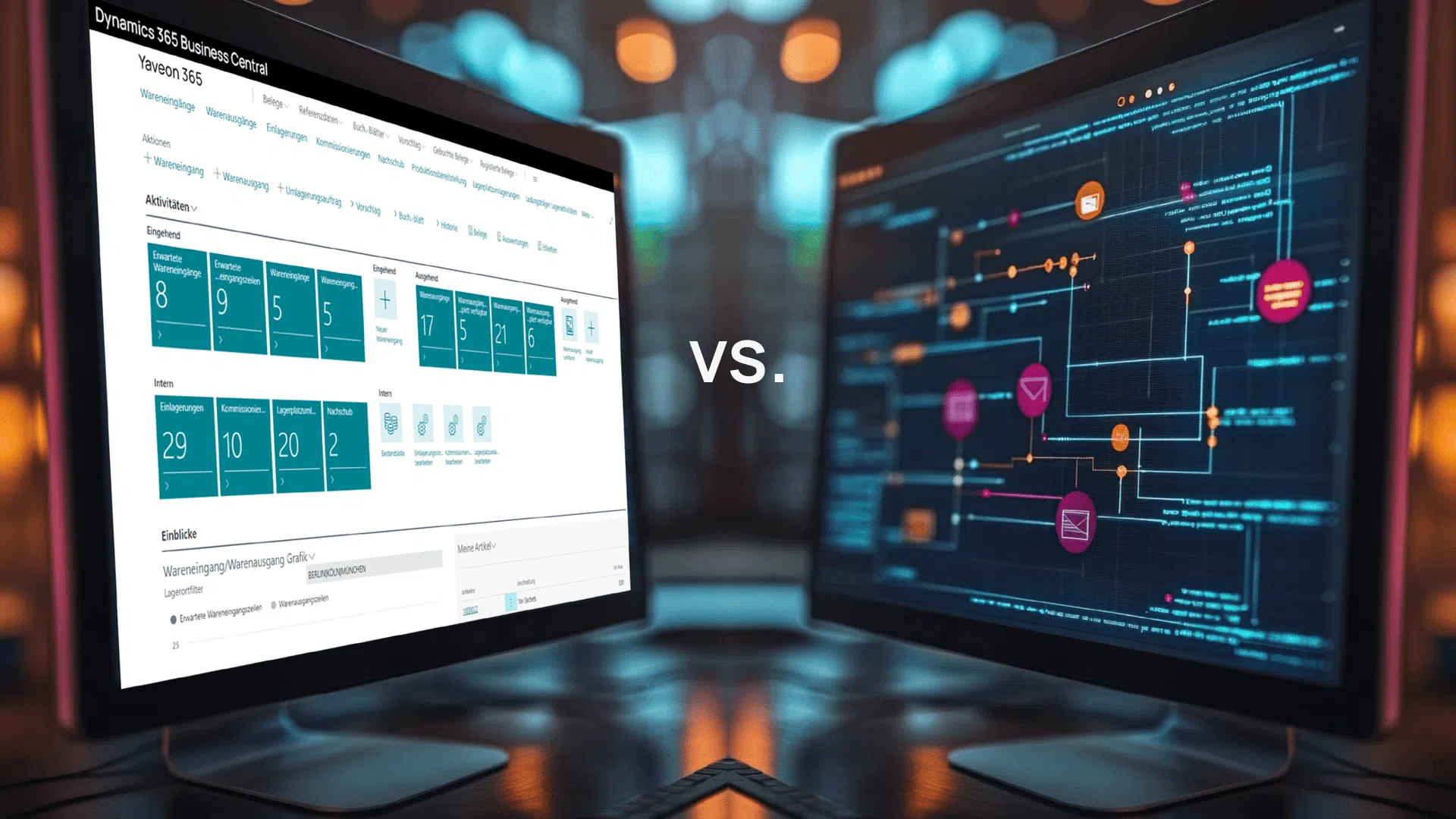
On closer inspection, many requirements in companies are not individual at all, but simply industry-specific. Pure standard software often falls short here. The solution: industry-specific software.
So what is industry-specific software, and why does it matter so much? An industry-specific ERP is a solution developed specifically for the needs of a particular industry. It bridges the gap between stable standard features and industry-typical necessities. The core standard processes remain stable, secure, and update-ready, while important industry-specific requirements are built in from the ground up. When needed, you implement individual modifications in a targeted, controlled, and economically sensible way.
Industry-specific software is essential in the following areas in particular:
They all have one thing in common: features such as batch management, end-to-end traceability, and strict quality control form the basis of daily operations. Manufacturing also differs significantly.
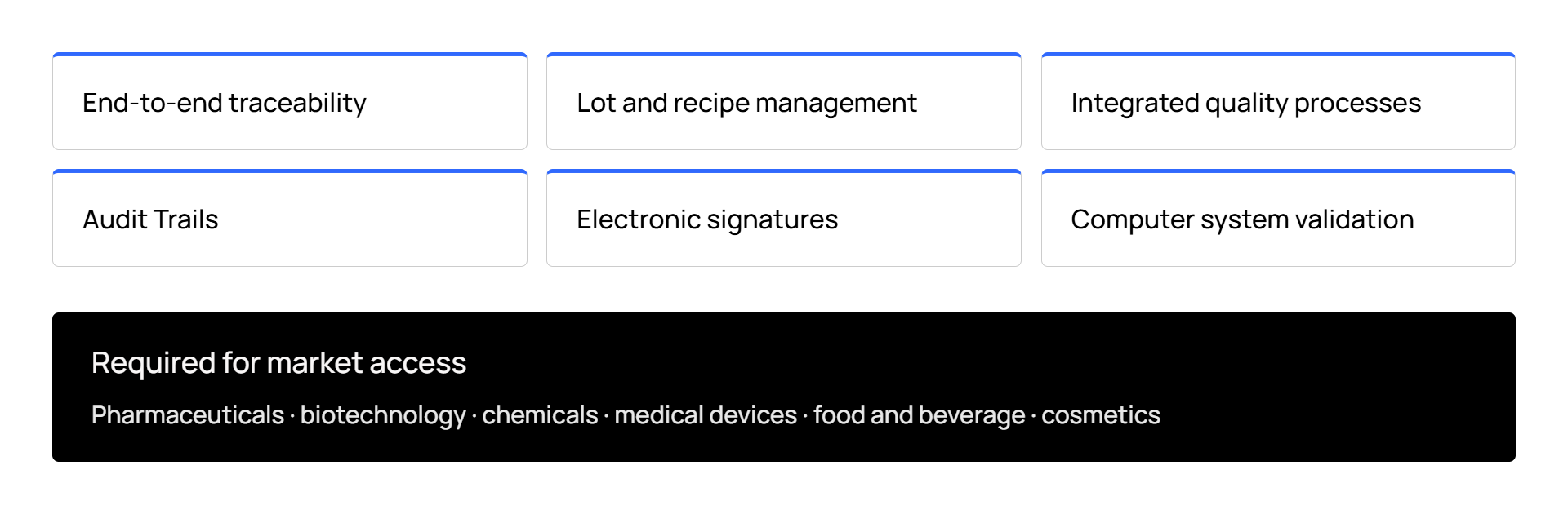
Companies in the process manufacturing industry operate in a highly complex and strictly regulated environment. At any time, they must be able to trace without gaps where a raw material came from and where the end product was delivered. Complete audit trails, secure electronic signatures, and computer system validation also shape the environment. These requirements are the mandatory prerequisite for being allowed to operate in the market at all. Pure standard software is simply not enough to support you reliably here.
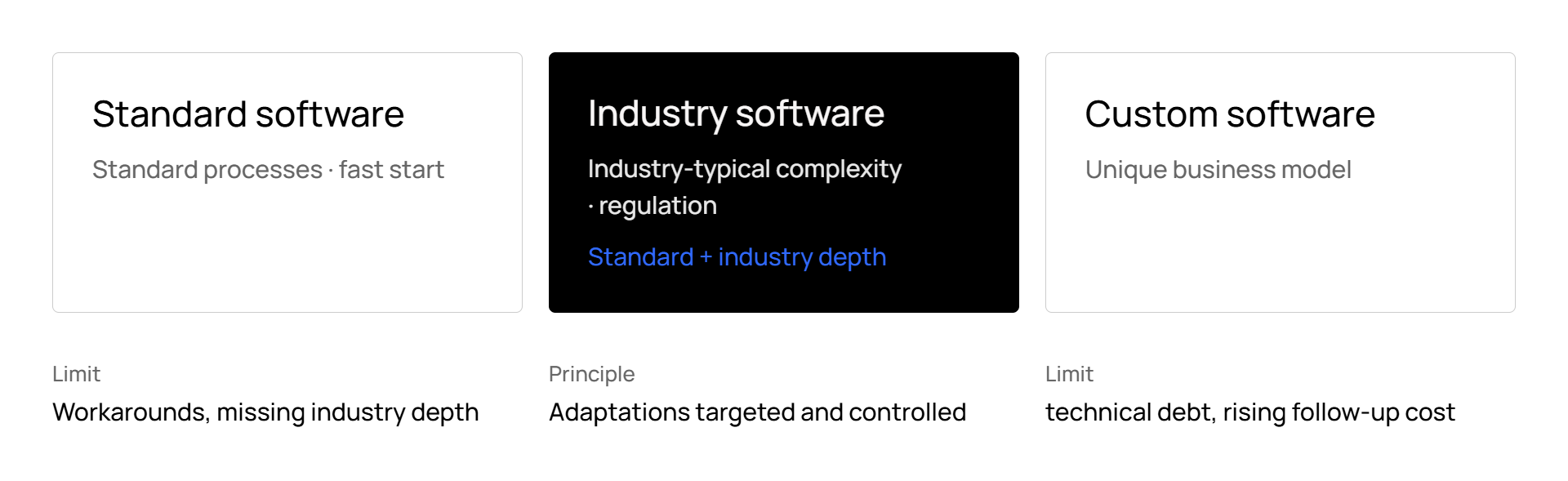
Less effort, fewer errors, more efficiency, and all of it in a single system? Yaveon 365 is a prime example of such an industry-specific ERP. Built on the proven foundation of Microsoft Business Central, our process manufacturing ERP extends the standard with exactly the features the industry needs.
These include:
Your key benefit: you get a powerful solution that is already tailored precisely to your industry. Without the unpredictable risks and costs of a complete in-house development.
The most important question in your digitalization project is not simply “standard software or custom software?” Rather, the question is: which solution best fits your processes, your employees, and your future growth in the long term? For many companies, the answer lies right in the middle. An industry-specific ERP such as Yaveon 365 combines smart standardization with the specialization you need. This reduces complexity, minimizes risks, and creates a future-proof foundation for your company.
Standard software provides ready-made features for typical business processes. Custom software, on the other hand, is developed specifically and tailored precisely to your requirements.
A typical example is Microsoft Business Central, a broad standard ERP solution.
Industry-specific software is an ERP system tailored to a particular industry, for example with features for batch management or quality control.
Custom software offers high flexibility and maps your processes exactly, down to the last detail.
Custom software means high development effort, rising maintenance costs, and growing complexity over the long term.
Standard software can only be adapted to a limited extent and reaches its limits with complex or industry-specific requirements.
Custom ERP development is only worthwhile if your processes are unique and give you a clear competitive advantage.
 Success story: Sirio Pharma Germany – Beitrag öffnen
Sirio Pharma implements an ERP system that meets computer system validation requirements.
 Is your ERP driving growth or merely maintaining the status quo? – Beitrag öffnen
Find out whether your ERP drives growth or slows it down, and check how future-ready your system really is today.
 ERP switch: When it makes sense – Beitrag öffnen
When an ERP switch pays off, what risks are involved, and how to make the transition a success.