

Sanity implements a validated ERP solution in the public cloud and drives efficiency with automation and more.




Summary:
ERP costs in a project go far beyond the software itself. Implementation, existing data quality, integrations, and ongoing operations play an equally important role. On top of that come often underestimated factors such as change management and temporary productivity losses. In regulated industries, compliance and validation requirements add further complexity. Companies that plan all direct and indirect costs realistically from the start and rely on standardized, industry-specific solutions reduce risk and stay cost-effective in the long run.
Depending on company size, requirements, and implementation effort, an ERP project usually costs between roughly €25,000 and €750,000. For large, international, or highly regulated companies, it can be considerably more. On top of that come ongoing cloud ERP costs: monthly user fees as well as effort for support, extensions, and operations.
One key insight up front: the software alone does not determine the price. Complexity, customizations, integrations, and regulatory requirements are often the real cost drivers. In this article, you will learn how ERP costs break down, what applies specifically to the process manufacturing industry, and how to plan your budget realistically without falling into typical cost traps.
ERP projects cover a wide range of topics. Keep the following points in mind:
There is no one-size-fits-all answer to how costs differ by company size, and a fixed price list is impossible. The following figures do, however, serve as a rough guide to typical total costs. The actual effort depends on the number of users, processes, sites, industry, and degree of integration, and can only be determined through an individual assessment.
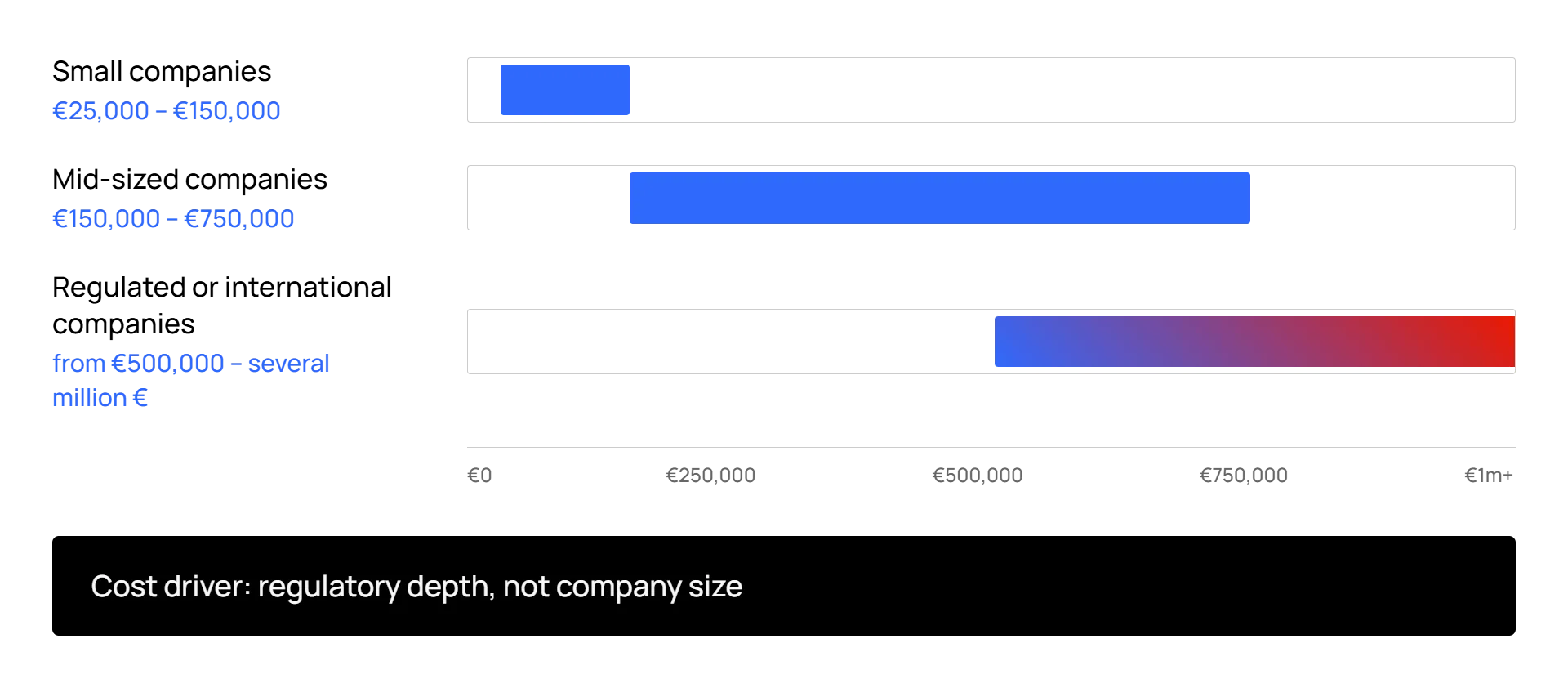
Good to know: Company size alone is not a reliable benchmark. In practice, a midsize company in the process manufacturing industry may need a considerably larger budget than a larger but less regulated company.
Before you approve a budget, you should have clear answers to these questions:
Ideally, capture your answers in an ERP requirements document: The more precise they are, the more solid your cost-benefit analysis.
To get a rough estimate, the following formula can help with initial budgeting:
Total ERP budget = software/subscription + implementation + data migration + integrations + training & change management + internal project effort + ongoing support/operations + risk buffer
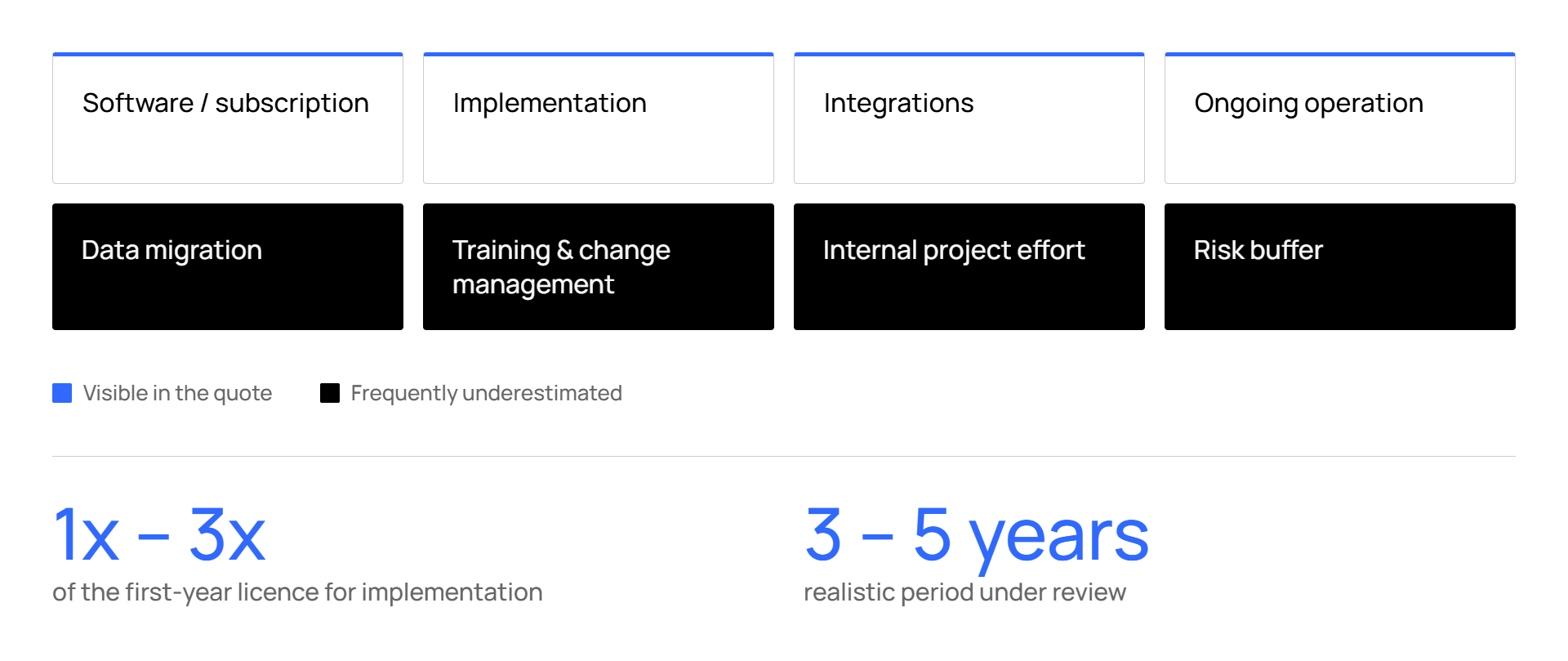
As a rule of thumb, 1 to 3 times the first year's costs for implementation is a benchmark that has proven itself in practice. Data, integrations, and scope changes typically have the greatest impact on the calculation.
Companies in regulated industries naturally plan validation, documentation, testing effort, and readiness for quality audits as a fixed part of the implementation effort from the start.
The biggest factors in implementation costs fall into the following blocks:
In the process manufacturing industry, costs rarely arise from more features but from non-negotiable requirements: traceability, recipe management, quality assurance, audit trails, documentation obligations, approvals, and regulatory evidence are usually mandatory.
A generic standard ERP quickly reaches its limits here. If industry-specific requirements are only added later through custom development, implementation costs, project risk, and validation effort rise significantly. The real cost trap is therefore often the lack of an industry-specific ERP solution. Companies that do not map batch logic, quality processes, and electronic signatures properly from the start end up paying more later.
Many ERP projects start with a focus on price alone. Over time, it becomes clear what they really are: comprehensive transformation projects. That is exactly where the problem lies.
Frequently underestimated cost drivers include:
SaaS solutions often speed up implementation, but data readiness and integration remain critical success factors. Budget overruns are then not an exception but a real risk.
But another cost trap lies in wait: Indirect costs mainly include downtime of key users, temporarily lower productivity during training and the transition, and additional effort for test runs, parallel operation, and rework. Costs caused by delayed decisions or unclear governance add to this.
These items do not appear in the quote, but they put a significant strain on the actual project budget. Anyone who compares license prices alone will inevitably underestimate the true ERP costs.
That leaves one question: cloud or physical server? The key differences are:
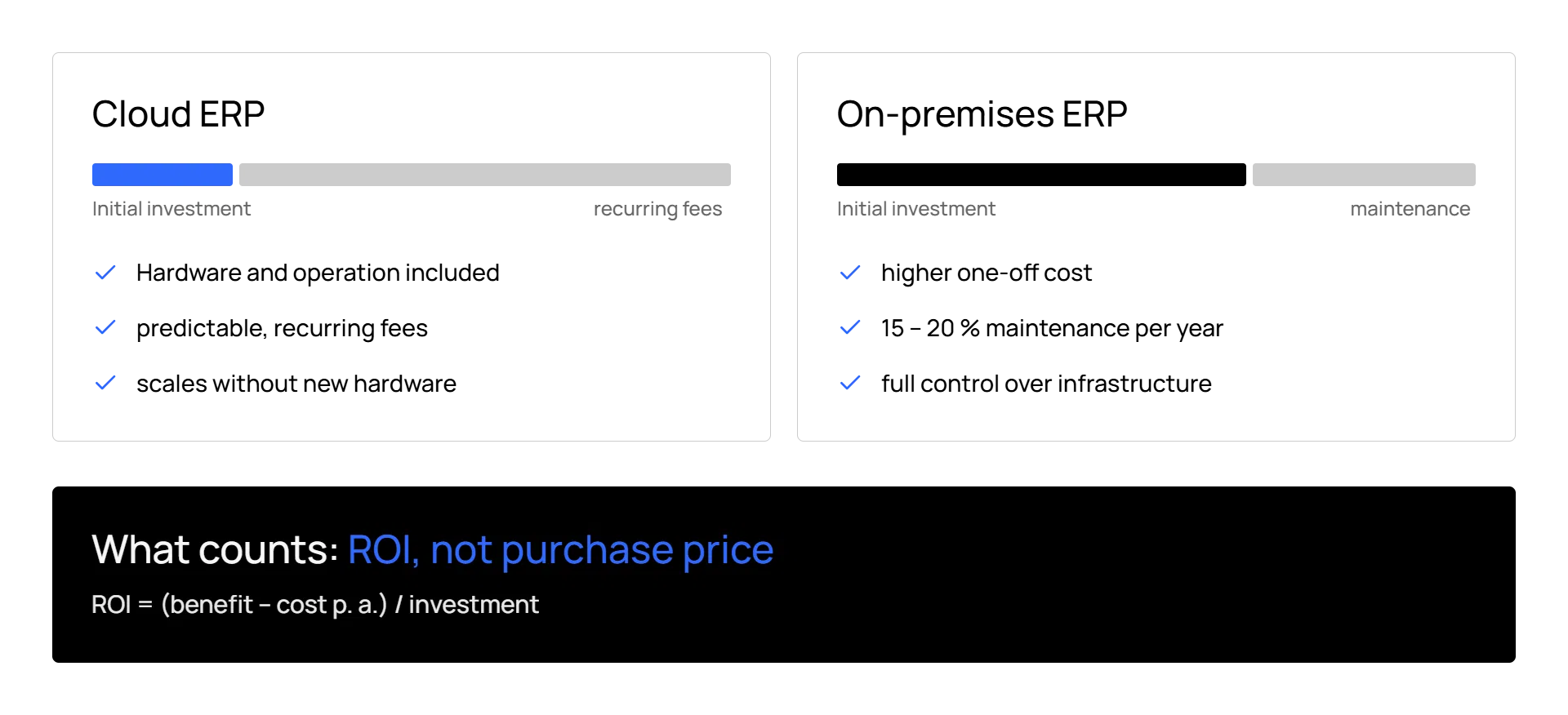
So which is cheaper? For many midsize companies, a cloud ERP is easier to plan financially, especially when internal IT resources are limited. Hardware also does not have to be kept up to date, for example when more users are added or more capacity is needed. The use of AI is also part of the solution. On-premises can make sense when there are special requirements for control, existing infrastructure, or specific deployment models. In regulated industries, however, it is ultimately not just the hosting model that matters, but whether the necessary controls, evidence, and processes are implemented reliably. The key question is therefore not: How much does an ERP system cost? But above all: When does it pay off?
A simple ROI approach can help with the decision:
ROI = (annual benefit - annual total costs) / investment
A midsize process manufacturer wants to bring finance, purchasing, production, quality, and traceability together on one platform, complemented by batch management, documentation, approvals, and an audit trail.
The budget typically consists of five blocks:
The key takeaway: It is not the number of users that drives costs, but the regulatory and process depth. A specialized industry solution is therefore often more cost-effective than trying to adapt a generic ERP after the fact. How exactly does that work?
Custom developments seem flexible at first, but in an ERP context they quickly become expensive: more specification, more testing, more upgrade risk, more documentation and validation effort. Every step has to be done individually and from scratch. An industry-specific standard addresses exactly the areas where ERP projects otherwise escalate: special cases, quality processes, traceability, and compliance. When these building blocks are available close to the standard, project effort, implementation risk, and long-term operating costs drop noticeably and sustainably.
One thing is clear: ERP costs cannot be reduced to a license price. Anyone who wants to calculate realistically has to look at the full picture: software, implementation, data, integrations, change, and operations. In the process manufacturing industry, compliance, audit-proof documentation, and industry-specific processes come on top.
The key question is therefore not just: Which ERP system should we select? But: How much standard really fits our industry? That is exactly where it is decided whether ERP costs remain predictable or become expensive later on.
The typical range is often €150,000 to €750,000, depending on the number of users, processes, integrations, and industry. In regulated industries, the effort can be considerably higher.
Usually not the software itself, but implementation, data migration, integrations, internal project effort, training, and change management.
Usage fees, extensions, support, and implementation effort determine the overall picture. For Microsoft Dynamics 365 Business Central, the current list prices in Germany are €69.30 (Essentials), €95.30 (Premium), and €6.90 (Team Members) per user per month with annual billing.
Internal resources, data cleansing, integrations, training, and scope changes are rarely priced in realistically at the start.
That depends on whether processes are harmonized at the same time, how many legacy systems are replaced, and which data needs to be migrated. Data and integration issues that only become visible late in the project often drive costs up unexpectedly.
Often, yes, if the system is implemented close to the standard, actually used, and aligned with real processes. Nucleus Research cites an average payback period of 16 months and an ROI of over 200% over the course of the project.
 Success story: Sanity Group – Beitrag öffnen
Sanity implements a validated ERP solution in the public cloud and drives efficiency with automation and more.
 The 10 biggest benefits of an ERP system – Beitrag öffnen
The 10 most important benefits of ERP systems – helping every company take the next step.
 ERP Selection Made Easy – Beitrag öffnen
Structured guide to ERP selection: criteria, costs, and typical mistakes for the process industry.